
Let’s dive into why small IAM exceptions can turn into serious security and compliance risks
Estimated reading time: 4 minutes
Most IAM environments do not collapse overnight.
They slowly lose control long before anyone realizes there is a problem.
Identity and Access Management (IAM) failures are rarely dramatic at first. Systems keep running. Employees keep working. Applications still authenticate users. On the surface, everything appears stable.
This makes IAM risk difficult to detect.
How harmless access decisions create long-term risk
In many organizations, IAM problems begin with decisions that seem harmless. A temporary role is granted to avoid delaying a project. An employee changes departments but keeps previous permissions “just in case.” A manual exception is approved during a busy quarter and never reviewed.
None of these actions look dangerous individually, but over time they begin to accumulate.
Large enterprises constantly evolve. Teams expand, cloud applications are added, contractors rotate in and out, and business responsibilities shift across departments. Access environments become more complex, while governance processes struggle to keep pace. As a result, permissions begin growing faster than they are reviewed or removed.
According to Gartner, a significant percentage of security failures are linked to inadequate management of identities, access, or privileges — especially in environments where governance processes fail to keep up with operational complexity.
This is how IAM complexity develops — quietly, gradually, and often invisibly.
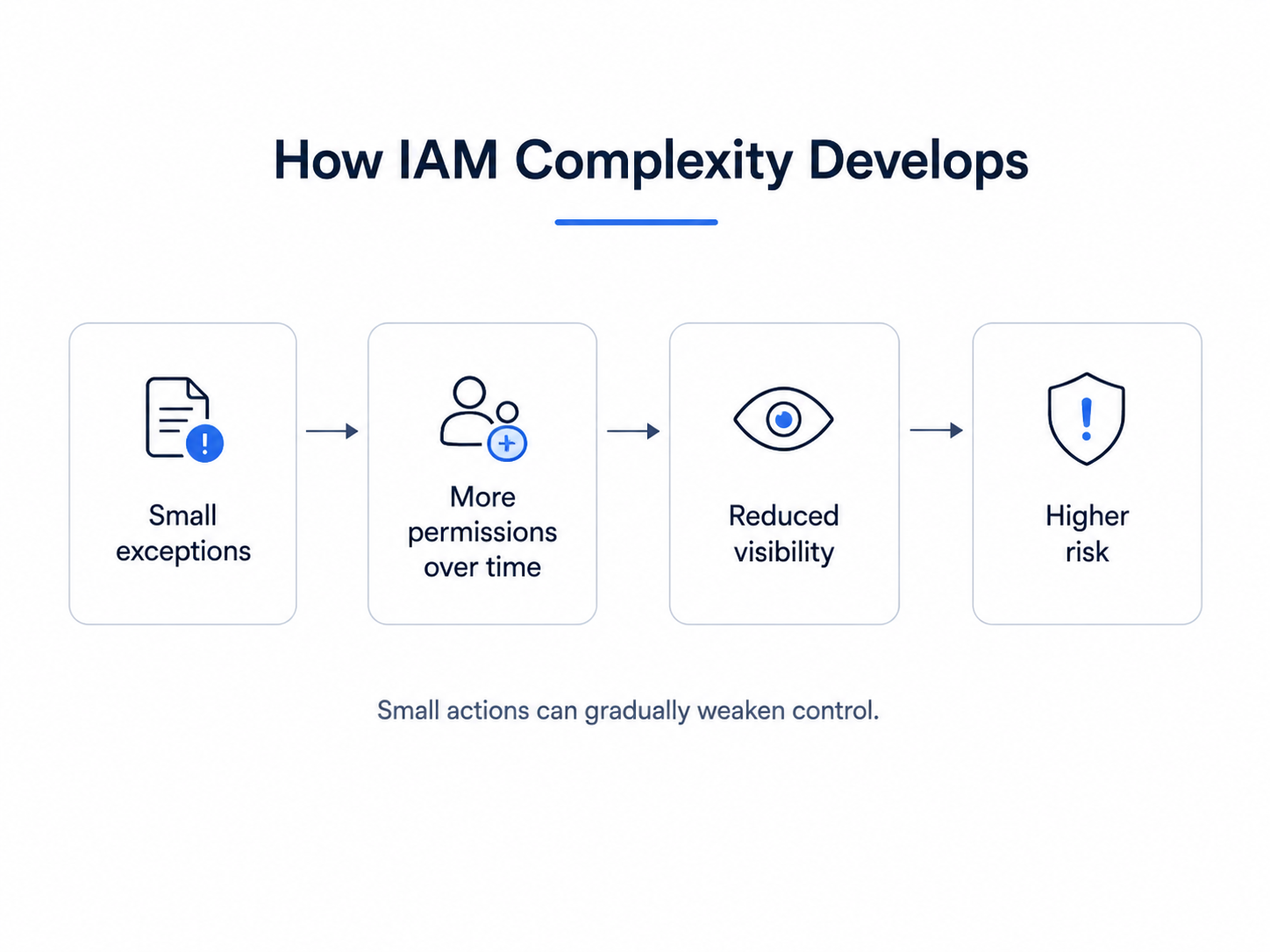
How IAM complexity develops over time
The issue is rarely one catastrophic failure. More often, it comes from operational processes that “mostly work” but drift away from structured governance. Temporary access becomes permanent. Exceptions stop being tracked. Role structures expand beyond their original purpose. Eventually, nobody has complete visibility into who actually has access to what anymore.
Technology alone is not enough!
A common misconception is that technology alone solves the problem.
Organizations invest heavily in identity platforms, automation tools, and compliance frameworks expecting them to automatically maintain control. But even advanced IAM technology cannot compensate for inconsistent governance or lack of operational ownership.
IAM is often treated as a one-time implementation effort with a defined endpoint. A company deploys a platform, integrates several applications, satisfies an audit requirement, and considers the project complete. In reality, IAM is not static. Business environments change, and identity governance has to evolve with them.
Without continuous attention, access structures become unreliable. Permissions remain active long after they are needed. Departments begin creating unofficial workflows to bypass delays. Manual processes slowly replace standardized governance.
Organizations stop trusting their identity data.
Access reviews become less effective when teams no longer trust the information they are reviewing. Cleanup initiatives get postponed because the environment feels too complex to untangle safely. Over time, operational debt continues building in the background.
Why hidden IAM risks are difficult to detect
These problems rarely create immediate disruption.
No major outage announces that control is weakening. Instead, visibility fades gradually until risks become visible during a compliance audit, security investigation, or internal review.
This is why modern IAM programs increasingly focus on operational intelligence and continuous visibility rather than only deployment. Organizations need ongoing insight into how permissions evolve, where governance gaps appear, and which access patterns may create long-term compliance or security risks across environments.
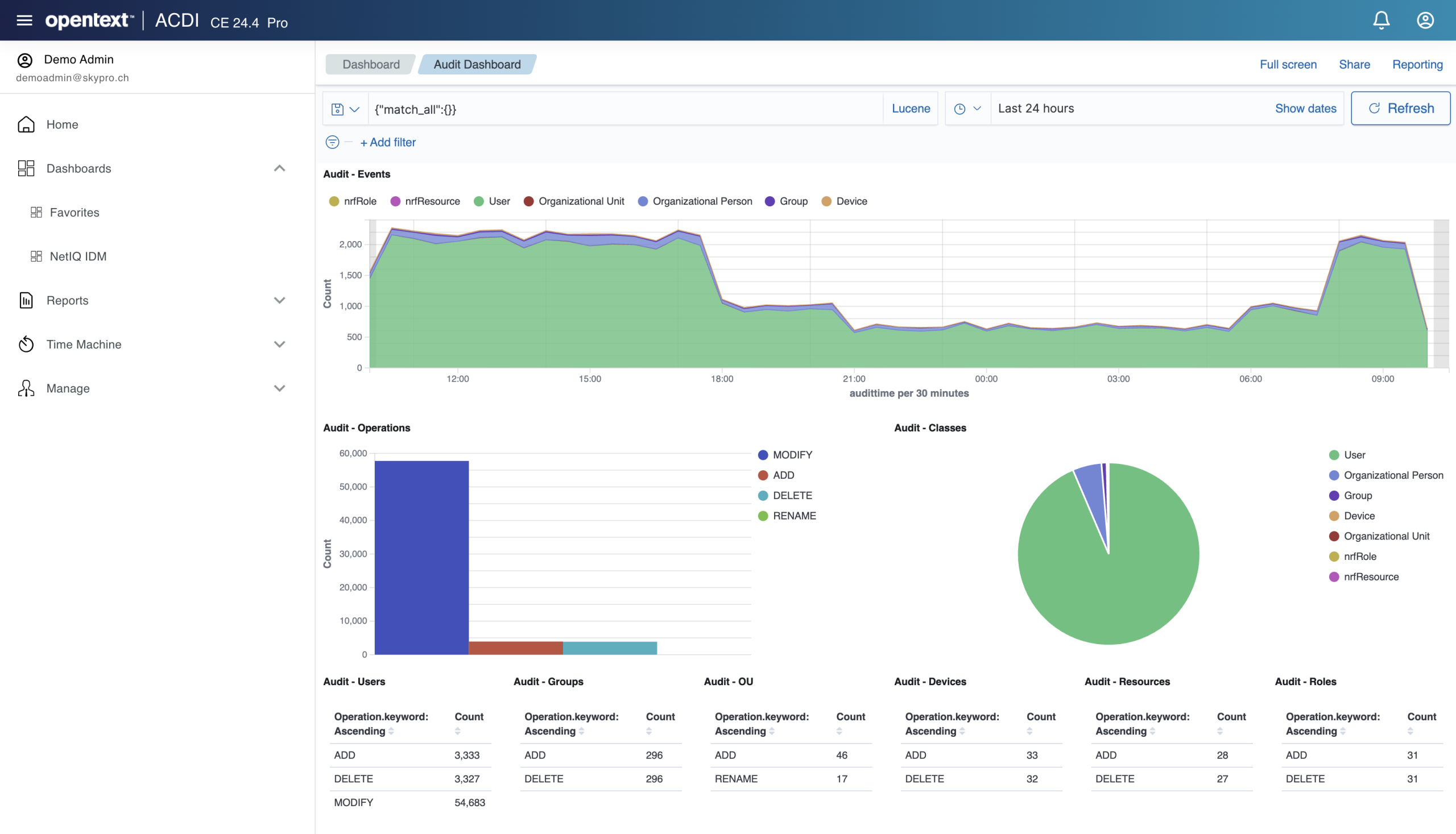
Here is where we step into the game…
Solutions such as ACDI bring more transparency and observability into complex IAM environments. By combining dashboards, reporting, compliance monitoring, and visibility into identity-related changes, organizations gain a clearer understanding of what happens across their access landscape. Instead of relying solely on fragmented manual reviews, security and IAM teams can identify inconsistencies faster and maintain stronger audit readiness over time.
Organizations with mature IAM strategies usually share several common characteristics: clearly defined ownership, consistent entitlement reviews, standardized onboarding and offboarding processes, reduced reliance on manual exceptions, and continuous monitoring across environments.
Technology supports governance, but it does not replace accountability.
Ultimately, the biggest IAM risks rarely come from a single technical failure. More often, they develop slowly through accumulated complexity, inconsistent governance, and years of unmanaged exceptions. By the time the problem becomes visible, the underlying issues have existed much longer than anyone realized.
Final thoughts:
IAM projects rarely fail because of one sudden technical issue. More often, they fail quietly when small exceptions, outdated permissions, and weak governance processes accumulate over time. Without continuous visibility, organizations may lose control long before the risk becomes obvious.
This is why modern IAM strategies need more than implementation alone. They require ongoing monitoring, clear ownership, and reliable insight into access activity across the environment that organizations gain by utilizing such tools as ACDI for their Identity & Access Management.