
Going from raw identity data to security intelligence
Estimated reading time: 4 minutes
If your SOC team looks like extras from a zombie movie – blame the logs. Every login attempt, password reset, and random OAuth prompt spits out another data point. Collecting identity data isn’t the problem anymore. In fact, you are probably suffocating in it. The real nightmare is finding an actual threat inside the daily mountain of noise.
Firewalls still matter, but they won’t save you when an attacker has a valid password. Why bother writing a complex zero-day exploit when you can just log in as Steve from accounting? To catch credential abuse before your company becomes tomorrow’s news headline, security teams need proactive Identity Telemetry. It is time to turn raw, chaotic identity events into clear, actionable security signals.
The Noise Floor: Why raw logs are not signals
Reviewing raw logs feels like listening to radio static. A single user logging into five SaaS apps generates dozens of disparate log entries. These logs sit scattered across Active Directory, cloud providers, and identity platforms.
According to the Verizon Data Breach Investigations Report, over 60% of breaches involve the human element. Attackers rely heavily on stolen credentials, social engineering, and password spraying. Data from the CrowdStrike Global Threat Report shows a similar trend. Identity-based attacks dominate initial access vectors. Adversaries strongly favor credential misuse over breaking code.
The core problem is not a lack of monitoring. The problem is confusing raw events with actionable signals:
- Identity Events: Low-level data points stating what happened (e.g., User_A logged in from 192.168.1.10 at 9:00 AM).
- Identity Signals: Contextualized insights explaining why it matters (e.g., User_A logged in from an unknown IP address 10 minutes after a privilege elevation request).
Without structured Identity Event Monitoring, critical threat indicators remain buried under millions of routine events.
Decoding the Signal: From raw events to high-fidelity insights
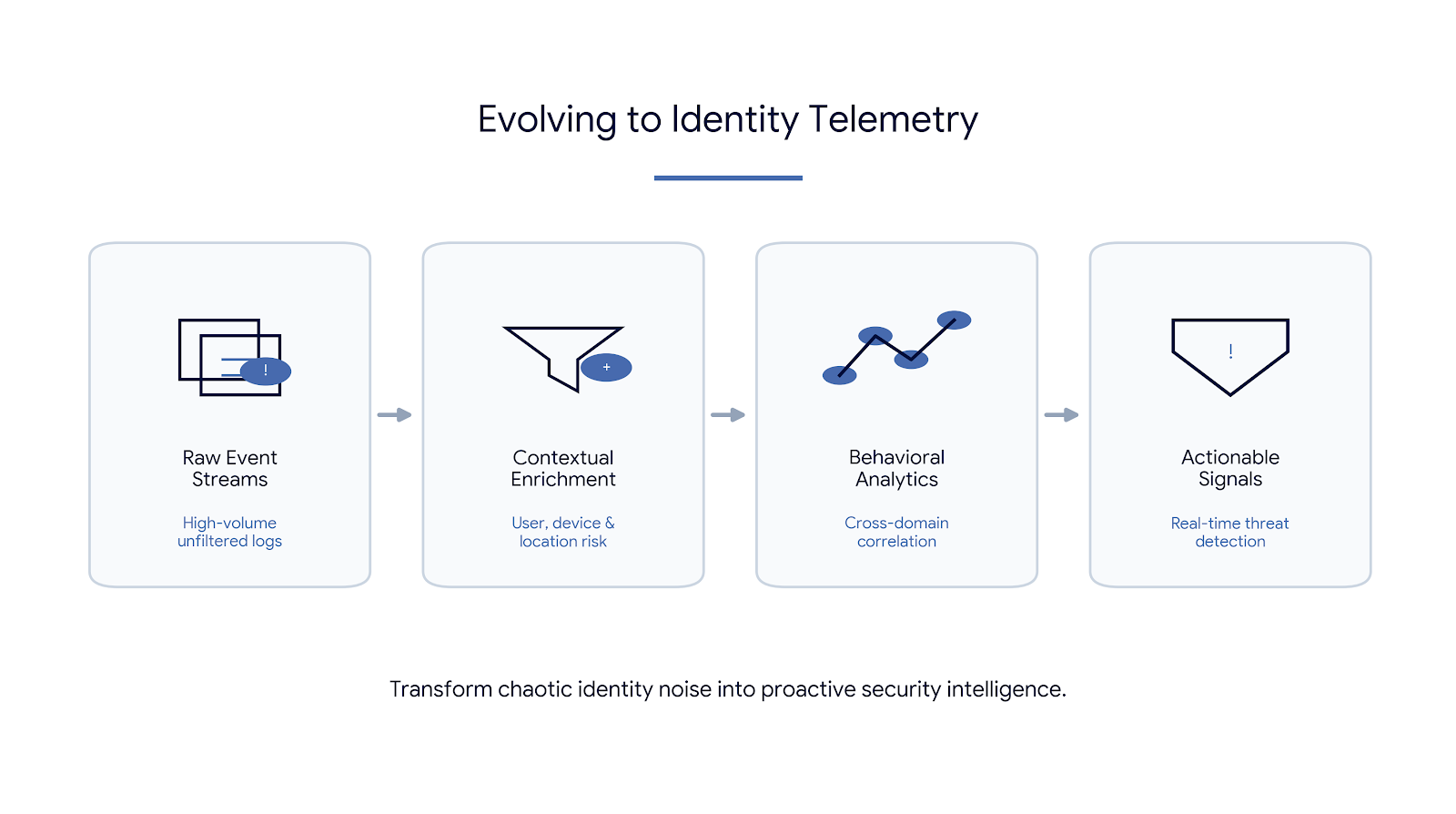
Raw data streams need continuous enrichment and correlation. Identity Telemetry bridges the gap between IAM architectures and security operations. It converts isolated authentication logs into multidimensional threat intelligence.
Effective identity security relies on four key operational pillars:
- Contextual Enrichment: Combine user risk profiles, group memberships, device health, and location data. This helps you evaluate the legitimacy of every access request.
- Behavioral Baselining: Track past access patterns over time. Spot sudden shifts like impossible travel or unexpected API calls.
- Cross-Domain Correlation: Map identity data directly to endpoint and network activity. This lets you detect lateral movement across hybrid cloud environments quickly.
- Automated Escalation: Generate high-fidelity Identity Signals that trigger rapid incident playbooks, such as stepping up authentication or revoking active session tokens.
By leveraging Identity Security Analytics, security teams establish dynamic baselines. You can automatically flag malicious deviations before attackers gain a permanent foothold.
Scaling intelligence: Centralizing Identity Telemetry
Modern identity ecosystems span legacy directories, cloud IdPs, and multi-cloud environments. Centralizing high-volume identity data is a major engineering challenge. CISOs, IAM engineers, and security admins need clear visibility without adding operational friction or tool sprawl.
Solving this requires specialized analytics platforms capable of unifying disparate data streams. A proven example is Audit, Compliance & Data Intelligence (ACDI). Solutions built for complex IAM environments transform raw, high-volume inputs from identity vaults, Active Directory, and managed applications into structured visual telemetry.
By providing unified dashboards, snapshot engines for historical analysis, and automated compliance reporting, these tools let security analysts run forensic investigations in seconds instead of hours. Integrating Identity Security Analytics into your broader SOC workflow gives both compliance auditing and threat detection a single source of truth.
Operationalizing Identity Telemetry for the enterprise
Transitioning to telemetry-driven defense requires active collaboration across IAM analysts, system admins, and SecOps teams. Here are key practical steps to get started:
- Unify Log Schemas: Standardize identity log formats across cloud providers and directories for consistent ingestion.
- Prioritize High-Risk Telemetry: Focus initial detection rules on critical identity events, such as MFA bypass attempts, service account modifications, and Active Directory schema changes.
- Adopt Continuous Signals: Move past point-in-time login checks. Monitor active user sessions continuously using standards like CAEP (Continuous Architecture Event Provisioning).
- Align IAM and SecOps Teams: Help SecOps analysts understand identity context. Ensure IAM teams build policies using real-time threat intelligence.
Final thoughts:
IAM projects rarely fail because of one sudden technical issue. More often, they fail quietly when small exceptions, outdated permissions, and weak governance processes accumulate over time. Without continuous visibility, organizations may lose control long before the risk becomes obvious.
This is why modern IAM strategies need more than implementation alone. They require ongoing monitoring, clear ownership, and reliable insight into access activity across the environment that organizations gain by utilizing such tools as ACDI for their Identity & Access Management.